When someone has served in the Armed Forces or in a uniformed service such as the police, fire or emergency services, their funeral often feels like more than a private farewell. It is also a moment to recognise duty, courage, loyalty and public service.
A carefully designed military or service‑themed funeral order of service can help you show that respect in a dignified, appropriate way. It gives you space to include ranks, decorations, photos in uniform and references to service life, while still keeping the booklet warm, human and personal.
In this guide, we’ll cover:
- What military and service funeral templates are
- Types of patriotic and regimental designs
- The meaning of common symbols (flags, poppies, badges, medals)
- How to include military honours and tributes in the order of service
- How to choose and customise a military or police template
- Design do’s and don’ts so it remains respectful and appropriate
- Frequently asked questions from families of veterans and serving personnel
When you’re ready to begin designing, you can browse all styles – including Military and Police themes – here:
Free funeral order of service templates – easily customisable.
What Is a Military Funeral Order of Service Template?
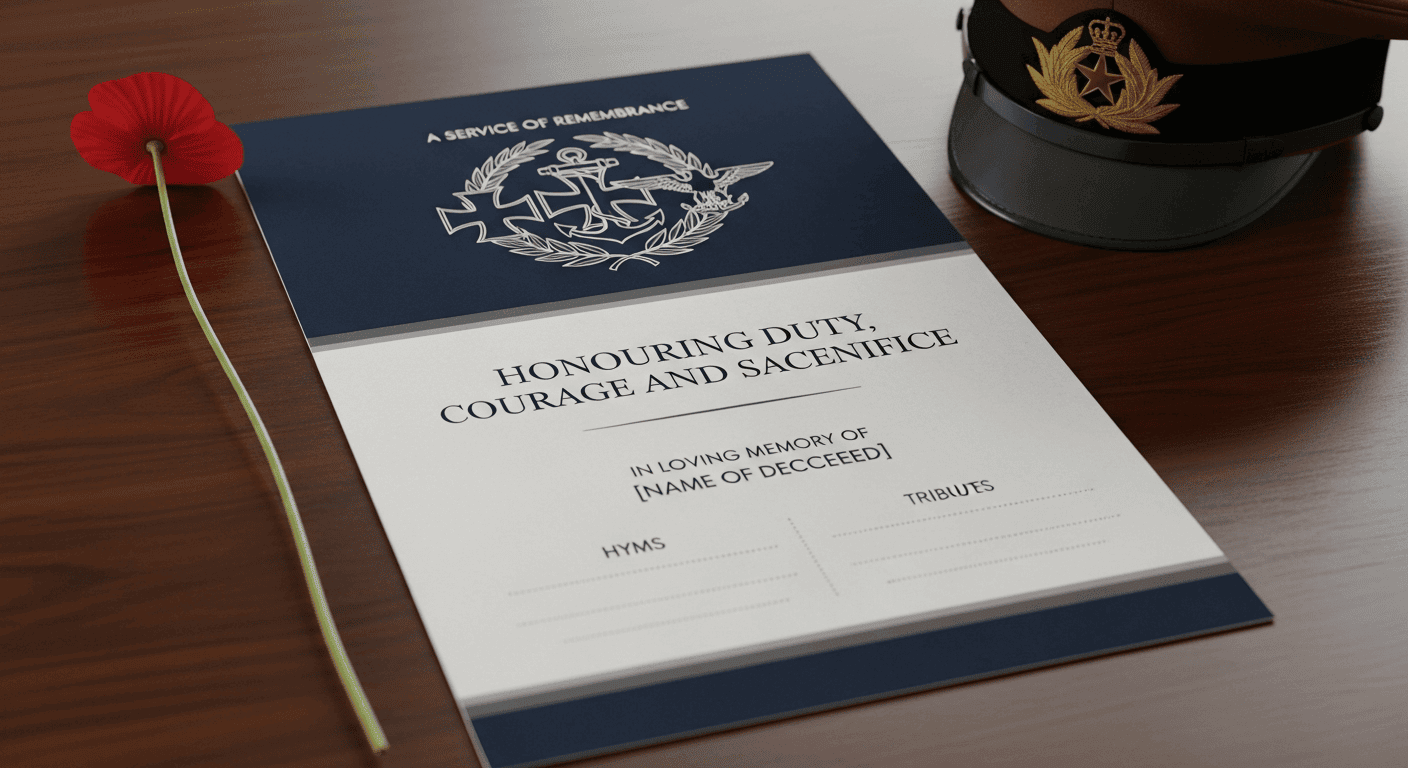
A military or service funeral order of service template is a pre‑designed booklet layout created specifically to honour:
- Members and veterans of the Armed Forces (Army, Royal Navy, RAF, Royal Marines)
- Police officers and other law‑enforcement staff
- Firefighters and emergency service personnel
- Reservists and those who served in allied or Commonwealth forces
These templates are built to:
- Highlight the person’s service history and rank
- Allow space for photos in uniform and with their unit or colleagues
- Incorporate patriotic or regimental colours and symbols
- Include military honours or ceremonial elements in the running order
Instead of designing all of this from scratch, you start with a layout designed by professionals, and then customise it using our online editor.
You can learn more about how templates work in general here:
Complete guide to funeral order of service templates.
When your design is ready, you can have it professionally printed with our free UK delivery.
Types of Patriotic & Service Designs
Within the “Military and Police” style category, there are several different approaches you can take. The right one depends on how prominently you want the person’s service to appear in the booklet.
1. Regimental and Branch‑Themed Templates
These designs subtly reflect the branch or regiment without overwhelming the content. They might include:
- Colour palettes inspired by regimental or corps colours
- Simple silhouettes of ships, aircraft or marching figures
- Discreet placement of a cap badge or emblem (if you have permission and a good‑quality image)
- Formal, traditional typography that feels in keeping with ceremonial uniforms
These are ideal if:
- The person was particularly proud of their regiment, ship or squadron
- The service is being attended by serving personnel or veterans
- You want the order of service to sit comfortably alongside uniforms, medals and standards
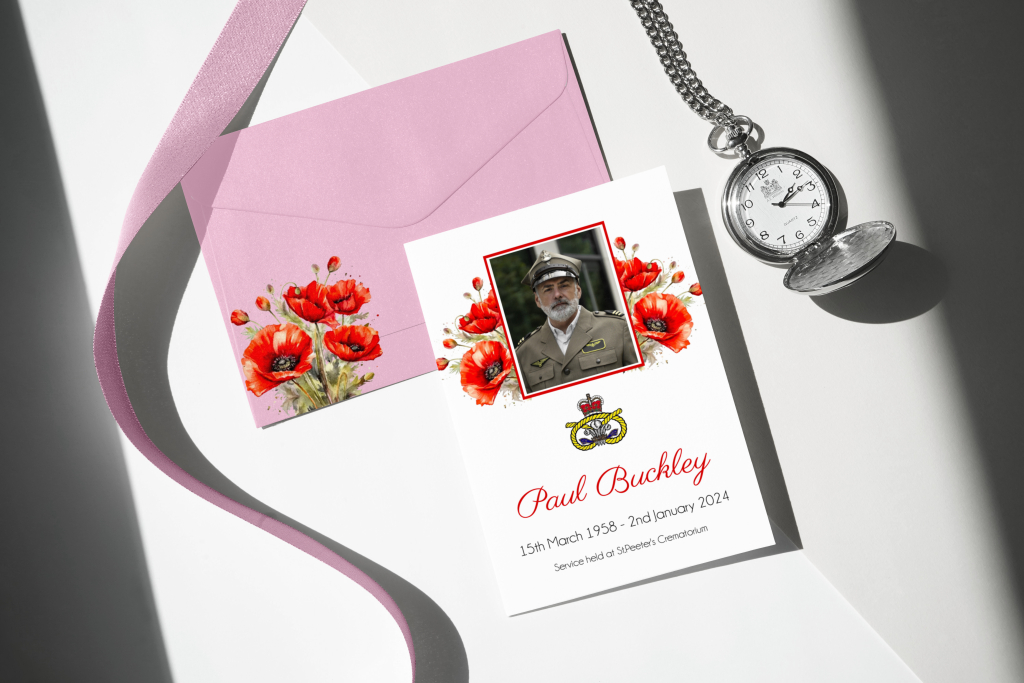
2. Poppy and Remembrance‑Themed Templates
The poppy is a powerful symbol of remembrance across the UK and Commonwealth.
Poppy‑themed designs may feature:
- Single or scattered red poppies around the border
- Fields of poppies in soft focus as a background image
- Subtle poppy line drawings in black and white for a more understated look
These templates are often chosen for:
- Veterans of major conflicts
- Those closely involved with the Royal British Legion or remembrance parades
- Services held near Remembrance Sunday or 11 November
3. Flag and National Colours
Some families prefer designs that incorporate:
- The Union Flag or national flag
- Patriotic colour schemes (navy, red, white)
- Abstract treatments of flags as softly blended backgrounds or diagonal stripes, rather than bold solid images
This style can feel particularly fitting if:
- The person had a strong sense of national service or pride
- They served on operations representing their country overseas
- The funeral includes other patriotic elements such as standards, salutes or national anthems
When using flags, it’s usually best to:
- Keep them tasteful and not overpowering
- Avoid distorting or recolouring official flags
- Use them in combination with clear, respectful typography
4. Uniform and Medal‑Focused Photo Templates
Modern templates often give a lot of space to photography. For military and police funerals, this may include:
- A strong cover portrait in full dress uniform
- Close‑up images of medals and decorations (with the person’s permission, if taken previously)
- Photos from parades, remembrance events or time in service
- A mix of service and civilian photos to show the whole person
These designs are perfect if:
- You have beautiful photos that capture them in service
- The family want guests to see both the public servant and the private person
- You are planning a “celebration of life” with stories from both worlds
5. Police, Fire and Emergency Service Templates
For police and other uniformed services, dedicated templates may optionally include:
- Blue, navy or service‑specific colour palettes
- Discreet use of chequered patterns, badges or crests (if high‑quality artwork is available)
- Imagery such as a subtle skyline, emergency lights (used carefully) or service memorials
These designs aim to balance:
- Respect for the uniform and role
- Sensitivity to the circumstances of death, especially in line‑of‑duty cases
- A sense of community and support from colleagues and the public
If you need something very specific – for example, reflecting a particular constabulary or service – you can request a bespoke layout via the free custom template form on the templates page:
Request a free custom funeral template (scroll to the request form).
Appropriate Military & Service Symbolism: Using It With Respect
Symbolism is powerful, especially in the context of service. Used well, it honours a life of duty; used carelessly, it can feel incorrect or uncomfortable. Here are some key points.
Flags and National Symbols
- Use official flags in their correct proportions and colours.
- Avoid stretching, recolouring or placing heavy text directly over a flag image.
- A faded or semi‑transparent flag behind the text can work well if readability is maintained.
- If you’re unsure about using a particular national or regimental flag, keep it subtle or consult a veterans’ organisation.
Ranks, Badges and Medals
- Confirm the correct rank and post‑nominals (e.g. “Sgt”, “Lt Col”, “MC”, “MBE”) with family or official records.
- Only display medals and decorations that the person actually held.
- Use good‑quality images for cap badges, wings or crests; blurred or pixelated symbols can feel disrespectful even if well‑intentioned.
- Consider including a short line such as: “Formerly of [Regiment/Unit/Force]” or “Proudly served in [branch] from [year] to [year].”
Religious vs. Secular Tone
Many service funerals are religious; others are secular. Your choice of symbols should match:
- Religious service: Crosses, doves or faith‑specific imagery can be combined with military symbols.
- Non‑religious service: Focus on flags, poppies, nature, light or abstract motifs instead.
If you’re unsure how to phrase the religious or secular parts of the text, your main writing guide will help:
How to write a funeral order of service guide.
Including Military Honours in the Order of Service
Some funerals for service personnel include formal military honours, while others include a simpler tribute. Your order of service can reflect this clearly, so guests know what to expect.
Common Military and Service Elements
These may include:
- Guard of honour or bearer party
- Standards or flags being carried and dipped
- The Last Post and Reveille
- A minute’s silence
- Laying of wreaths or poppies
- Reading of the Exhortation or act of remembrance
- Presentation of the flag or cap to the family
Your booklet might set these out like:
- “The Last Post (bugler)”
- “Act of Remembrance and Minute’s Silence”
- “Standards are lowered”
- “Wreaths are laid by family and representatives of [regiment/force]”
Example Order of Service with Military Honours
Here is a simple example structure you can adapt:
- Entrance music (optional guard of honour)
- Welcome and opening words
- Hymn or reflective music
- Reading or tribute from family
- Eulogy including service history
- Act of Remembrance
- The Exhortation
- The Last Post
- Silence
- Reveille
- Prayers or secular reflection (if desired)
- Committal or closing words
- National anthem or final piece of music
- Recession of coffin with standards
For more layout examples, including non‑military versions you can blend with this, see:
Funeral Order Of Service Examples & Ideas.
Always coordinate with:
- The officiant (vicar, priest, celebrant)
- Any regimental or police representatives
- Your funeral director
to ensure what’s printed matches what will actually take place.
How to Choose the Right Military or Service Template
With several patriotic and service‑based designs available, here’s how to narrow down your choice.
1. How central is their service to the story you want to tell?
- Central and defining: Choose a template that strongly features uniforms, flags or regimental colours.
- Important but not everything: Use a more neutral design with a dedicated page for service history and one key photo in uniform.
- Part of their life, but they were more known for other things: Consider a subtle poppy or small emblem alongside a hobby or floral design.
2. What kind of service is being held?
- Full military honours or service funeral: Stronger ceremonial imagery, formal typography, traditional layout.
- Quiet family funeral with a small tribute section: Softer, more understated designs with a modest mention of service.
- Public memorial: Perhaps a bolder patriotic design, especially if colleagues and the public are attending.
3. What will feel right to the person themselves?
Ask: “If they could see this, what would they think?”
- Would they be proud to see a bold flag and their medals on the cover?
- Or would they prefer something quieter, with just a line mentioning their service and a small crest?
Your design should feel like something they would have approved of.
Customising a Military Template Step by Step
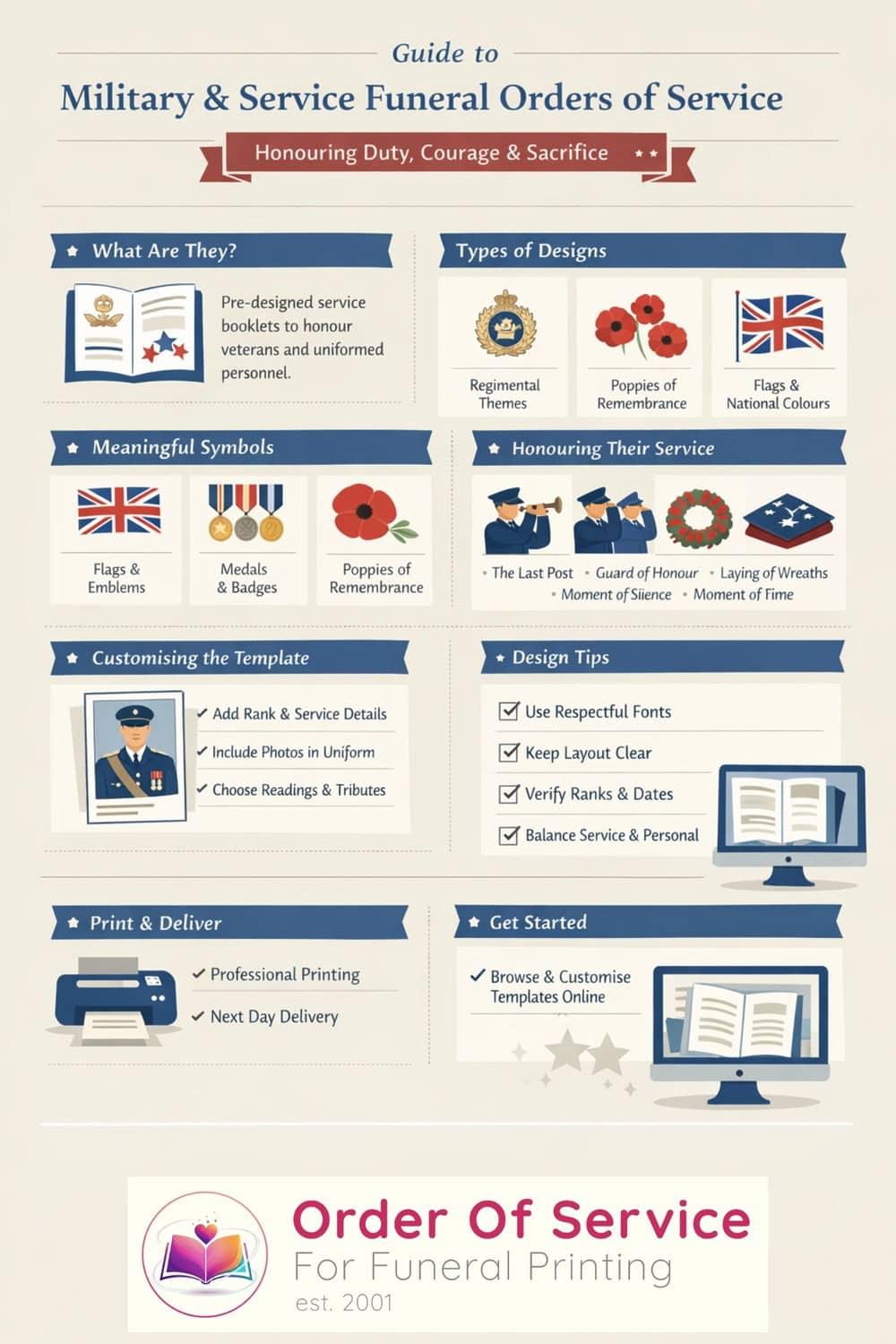
Once you’ve chosen a design from the Military and Police style section on the templates page, here’s how to personalise it.
Step 1: Gather Key Service Details
Collect:
- Full name and rank (including any honours if applicable)
- Branch (Army, Royal Navy, Royal Air Force, Royal Marines, Police, Fire & Rescue, etc.)
- Unit, regiment, ship, squadron or force
- Dates of service (if known)
- Medals and decorations
- Any specific readings, poems or prayers with service connections
You may also wish to include a short paragraph summarising their career.
Step 2: Add Service Information to the Cover and Inside Pages
On a military template, you might set the name line as:
Major John Smith MBE
1950–2024
Formerly of the Royal Anglian Regiment
Inside, you could add a section such as:
Service History
John enlisted in…
He served in…
He was awarded…
This gives guests a clear sense of the person’s contribution, especially those who may only know them from civilian life.
Step 3: Insert Photos in Uniform and Civilian Life
Where the template provides photo spaces:
- Use a strong, clear image in uniform for the cover or first inside page.
- Include one or two additional photos with family, friends or hobbies to balance the service theme with their life outside uniform.
- Consider a small close‑up of medals, cap, or beret on a later page as a quiet nod to service.
Step 4: Set Out Any Military Honours in the Running Order
If standards are being carried, buglers are playing or wreaths laid, make this clear in the text. This helps guests understand moments when:
- They may be expected to stand
- Silence will be observed
- Certain symbolic gestures will take place
Coordinate this carefully with your officiant and service representatives so what you print matches the actual ceremony.
Step 5: Proof‑Read with Care
Check:
- Every rank and unit name
- Spellings of ships, regiments and decorations
- Dates, especially of service and life
- All names of colleagues or representatives taking part
It’s worth asking someone who understands military or service terminology to look over it as well.
Step 6: Arrange Printing
For service‑themed booklets, a high‑quality print finish makes a real difference. On your site you can choose:
- Sturdy card for the cover
- High‑quality paper for the inside pages
- Optional matt or velvet lamination for a premium feel
Find full options here:
Funeral Order of Service Printing UK – Next Day Delivery.
Design Do’s and Don’ts for Military Funeral Templates
Do:
- Use clear, formal fonts that are easy to read.
- Keep symbols (flags, badges, poppies) sharp and high‑quality.
- Balance service imagery with personal photos and warm wording.
- Confirm all service‑related details with someone who knows.
- Use respectful language throughout – especially in headings and tributes.
Don’t:
- Guess at ranks or medals – always verify.
- Overcrowd the cover with too many symbols at once.
- Use novelty fonts or bright, clashing colours.
- Place long blocks of small text over busy background images.
- Feel you have to make everything about uniform; remember the person beyond their role too.
FAQs About Military & Service Funeral Order of Service Templates
Can I use official regimental badges or crests in the design?
Yes, if you have a good‑quality image and the right to use it. Many families use scanned cap badges or crests. If you are unsure about permissions, keep the design more generic with colours and motifs instead.
What if I don’t know all the details of their service?
Include what you’re confident about – rank, branch, approximate years – and focus on the qualities they showed in service (courage, loyalty, leadership). You can always keep the wording general if details are unclear.
Are military templates only for full military funerals?
No. Many families choose a subtle military‑style design simply to acknowledge service, even at a small family funeral without formal honours.
Can I combine military imagery with floral or religious designs?
Absolutely. For example, you might choose a poppy‑based floral template with a small cross, or a simple border design that leaves space for a uniform portrait and a Bible verse.
Where should I start if I want to design one now?
Begin by browsing the templates and using the Military and Police style filters:
Free funeral order of service templates – easily customisable.
Once your design is ready, you can order printed copies with free UK delivery here:
Funeral Order of Service Printing UK – Next Day Delivery.